
Spread Betting
A structured, beginner‑friendly introduction to Spread Betting, designed to help you trade safely, understand risk, and avoid common mistakes.
This is an abreviated version - the full downloadable version is availble.
What you will find here;
- What is Spread Betting
- How it works
- A simple example trade
- Advantages and Disadvantages
- Beginner mistakes to avoid
What is Spread Betting?
Spread Betting is a way to speculate on financial markets without owning the underlying asset. Instead of buying or selling a product, you stake a certain amount per point of movement.
If the market moves in your favour, you profit.
If it moves against you, you lose.
Spread Betting is popular in the UK because:
- It's tax free (no Capital Gains Tax)
- You can trade Forex, Indices, Gold, Oil, Shares, Crypto
- You can go long or short
- You can trade with small starting capital
This guide explains Spread Betting in a structured, beginner‑friendly way — with examples, diagrams, and risk management rules.
How Spread Betting Works
Stake per Point
You choose how much you want to risk per point of movement.
Example: £1 per point.
Profit / Loss Calculation
Profit or loss = (Price movement in points) × (Stake per point)
The Spread
The spread is the difference between the buy and sell price. This is the broker’s fee .
Margin & Leverage
Spread Betting uses leverage, meaning you only deposit a fraction of the trade’s value.
Example: If margin is 5%, a £1,000 position requires only £50 to open.
Leverage increases both profits and losses — which is why risk management is essential.
Want to know more, then download the full guide.
Example Trade
Example: Long Trade on the FTSE100
- Buy price: 7,500
- Stake: £1 per point
- Stop loss: 7,480 (20‑point risk)
- Target: 7,540 (40‑point reward)
If the market rises to 7,540:
- Profit = 40 points × £1 = £40
If the market falls to 7,480:
- Loss = 20 points × £1 = £20
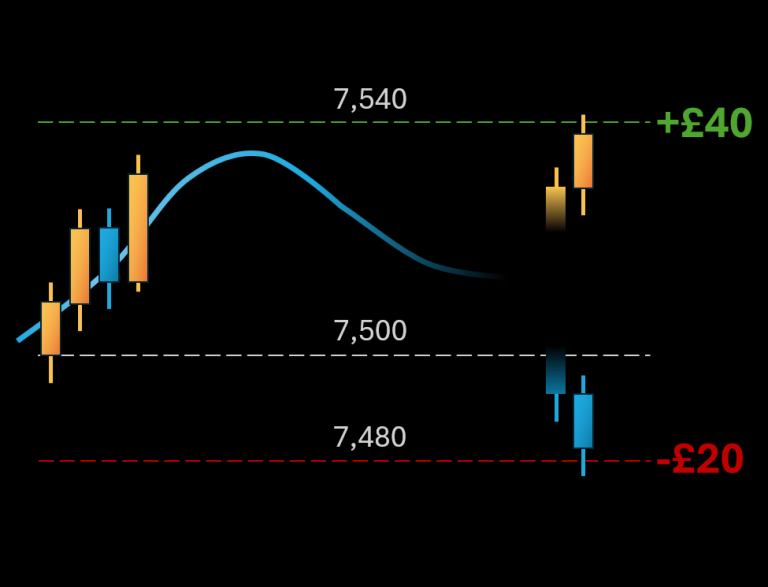
This example shows how Spread Betting works in practice — the full guide includes multiple examples, including losing trades, overnight financing, and margin changes.
Advantages and Disadvantages of Spread Betting
As with all trading and gambling, you should always assess the risks before proceeding. Here is a summary of the key Pro's and Con's related to online Spread Betting. For a more informative overview, please dowload our full Spread Betting Guide.
Advantages
- Tax Efficient
- Leveraged Trading
- Profits from boith rising and falling markets
- No Commission or Transaction Charges
- Wider Market Access
- 24 Hour Trading
Disadvantages
- Amplified Losses
- Rapid High Velocity Risk
- No ownershift of assets
- Emotional Trading
- Spread Widening
- No Tax Offset
Beginner Mistakes to Avoid
These are the most common mistakes new Spread Bettors make:
1. Trading too big
Using £5–£10 per point before understanding risk.
2. No stop loss
This is the fastest way to blow an account.
3. Overtrading
Taking too many trades leads to emotional decisions.
4. Trading news events
Spreads widen, slippage increases, and stops can be skipped.
5. Ignoring overnight financing
Holding positions overnight can add unexpected costs.
The full guide includes a complete Risk Management Framework, Daily Loss Limits, Weekly Drawdown Rules, and a Psychology Section.
The Complete Guide to Spread Betting
60 Page PDF document Includes:
- Full mechanics
- Multiple example trades
- Tax rules
- UK Broker
- Glossary
- FAQ
- Risk management
- Spread Betting vs CFDs
- Strategy teasers
- And more all for £39.00
Disclaimer
Educational content only. Not financial advice. Trading involves risk and you can lose money. algotrades.co.uk is not liable for any losses incurred from trading decisions.
See full Legal Notice here.